
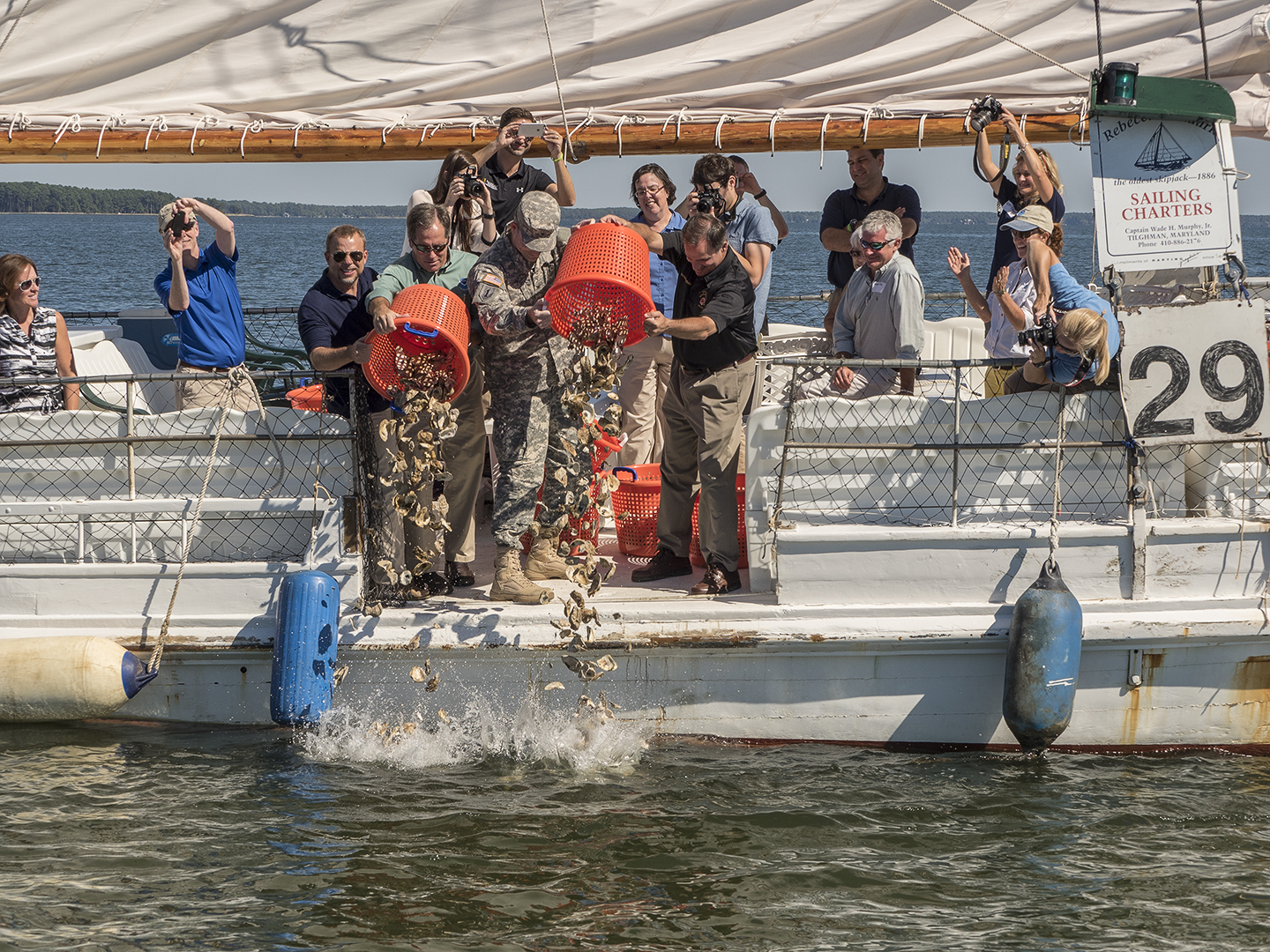
ORP is proud to share our recent peer-reviewed scientific publication, Tributary-scale oyster reef restoration in Harris Creek, Maryland: lessons from a decade of planning, implementing, and monitoring, published last week in the journal Restoration Ecology! The publication was led by our partners at NOAA and includes authors from NOAA, US Army Corps of Engineers, Maryland DNR, and ORP.
 Large-scale oyster restoration was initiated in Maryland and Virginia in response to centuries of declines in the native oyster population in Chesapeake Bay. Harris Creek, Maryland was the first tributary to receive large-scale restoration in the Bay. The restoration of 348 acres of reefs began in 2011 and concluded in 2020. Post-restoration monitoring was completed in 2021, providing the partnership an opportunity to reflect on the successes and lessons learned from conducting the first of ten large-scale projects in the Bay.
As of 2021, 98% of restored reefs in Harris Creek met the defined threshold for success. The publication highlights how success was achieved – emphasizing the importance of intentional goal setting and defining clear criteria to track project progress and measure success. The partnership collaboratively developed a restoration blueprint to guide project implementation by integrating pre-existing data on existing oyster habitat with field data from a comprehensive habitat survey to identify areas suitable for restoration and assign a restoration treatment type.
Success was also attributed to coordinated implementation of the work, with different partners providing funding and leading different components of the project based on their strengths and capacity. For example, ORP supported the in-water restoration through the production and planting of oyster spat-on-shell in partnership with the UMCES Horn Point Oyster Hatchery. ORP also conducted post-restoration monitoring to track success, and data were analyzed and discussed by the partnership. Underperforming reefs received additional treatment through the partnership’s adaptive management approach, which is outlined in the publication.
At the time of completion, Harris Creek was the largest oyster restoration project in the world, demonstrating the viability of large-scale, goal-driven restoration projects developed by this partnership. The framework developed for Harris Creek has since been applied to nine other tributaries in Chesapeake Bay – totaling nearly 2,000 acres of reefs in ten tributaries, completed in 2025 – and referenced as a model for large-scale oyster restoration around the world.
Beyond the implementation and planning of work at this scale, the publication highlights that diverse partnerships are essential to make the magic happen – facilitating access to funding, expertise, scientific capacity, and experience with public and political engagement to garner support. While the Harris Creek project is considered a resounding success, the road to success was often complicated and influenced by public input (both positive and negative) and logistical constraints along the way.
What’s next for Chesapeake Bay?
This growing body of science reinforces something we see every day in the field: Our approach to oyster restoration works.
The results are not instant, and restoration is not simple, but it is measurable, scalable, and increasingly proven through long-term data. And that’s exactly why Oyster
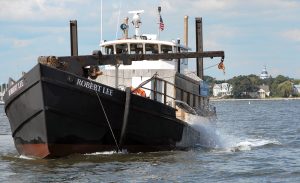
Recovery Partnership’s efforts matter. From reef construction to shell recycling to long-term monitoring, restoration is a full-cycle effort grounded in science and scaled for impact.
With the recent signing of the 2025 Chesapeake Bay Agreement in December, restoration partners and Chesapeake Bay jurisdictions committed to continuing oyster restoration at scale, building on the foundation developed for Harris Creek.
A milestone for ORP
This publication is especially meaningful because it reflects the contributions of ORP’s Executive Director, Ward Slacum, and ORP scientists, Dr. Olivia Caretti and Jennica Moffat, along with the broader efforts of our team, past and present. Seeing this work recognized in peer-reviewed scientific literature is validation that restoration efforts in Chesapeake Bay are contributing to the broader global understanding of how to effectively restore our coasts.